Alan Billis was an ordinary man with an unusual final wish. After learning he had terminal lung cancer, the former taxi driver agreed to let scientists preserve his body using methods based on ancient Egyptian mummification.
His choice gave researchers a rare chance to test old ideas with modern tools. It also gave the public a close look at how much skill, care, and chemistry went into making a mummy.
For ancient Egyptians, keeping the body intact had deep meaning. The body was tied to identity and the afterlife. That made preservation more than a practical job. It was part of a sacred duty.
The process was also highly practical. Water had to be removed. Soft organs had to be treated. Skin and tissue had to be protected from decay.
That is what makes the Alan Billis case so useful. It lets us compare old methods with modern science in a direct way.
The story also shows why good history works best when real people are at the center of it. That same human focus is part of what makes strong history storytelling easy to remember.
Why Egyptians Preserved the Body
Ancient Egyptians believed a person had more than a physical body. Ideas about the ka, the ba, and the afterlife shaped funeral customs for centuries.
A preserved body gave the dead a stable form. That is why embalmers worked so hard to slow decay and keep the person recognizable.
The exact method changed over time. Wealth also mattered. Still, the basic goal stayed much the same: remove moisture, protect tissue, and prepare the dead for burial.
If you enjoy seeing how old societies solved practical problems, the history behind ancient cacao drinks offers another look at how tradition, materials, and daily life came together.
Natron Did the Heavy Work
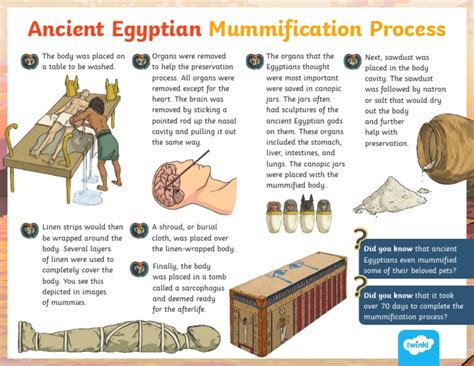
Natron was one of the key materials used in Egyptian mummification. It is a natural mix of salts. Its main job was to draw water out of the body.
This mattered because moisture helps bacteria and fungi grow. A dry body lasts much longer than a wet one.
Ancient embalmers also removed many internal organs. The heart often stayed because Egyptians gave it great spiritual importance.
The brain was often removed in ancient mummification, though methods varied. Alan Billis was different. In his modern procedure, his brain was left in place.
What Happened to Alan Billis
Billis died in 2011. He had agreed to donate his body for a project led by specialists who had studied ancient Egyptian preservation.
The team removed several internal organs. They drained body fluids and coated the body with a protective mix. Then they placed it in a natron salt bath for more than a month.
After that, the body was dried in warm, low-humidity conditions for about three months. It was then wrapped in linen.
King’s College London, which now houses the mummy, says later imaging showed that the finished body had features very close to mummies from Egypt’s 18th Dynasty. You can read the museum’s own account of the modern mummy project.
The case is a good reminder that history is often clearer when we can see the process step by step. The same idea helps explain why a visual project such as The Fallen of World War II can make large events feel more real.
Oils, Resins, and Linen
Drying was only part of the job. Egyptians also used oils, waxes, and resins. These could help seal and protect the body.
Some of these materials also had a strong smell. Others had properties that made it harder for microbes to grow.
Researchers study the residue left on mummies and wrappings to learn what was used. That work shows that ancient embalmers understood their materials through long practice.
Readers who want a simple reference at home can browse books on Egyptian mummification or introductory archaeology books.
A Human Story, Not Just a Science Test
The science is fascinating, but Alan’s choice is what gives the story its weight. He knew his body would become part of a study. He also knew that students and researchers could keep learning from him.
That makes his mummy different from an ancient royal burial. Yet both stories are about memory, care, and the wish to resist decay.
It also changes the way we see ancient embalmers. They were not simply following strange rituals. They were skilled workers using tested methods and valuable materials.
That mix of craft and belief is common across history. It can also be seen in places such as Chepstow Castle, where ordinary construction choices reveal how people lived, worked, and protected themselves.
What Alan Billis Taught Us
The project did not recreate every form of Egyptian mummification. Ancient Egypt lasted for thousands of years, so no single method can stand for every period.
Still, the experiment showed that natron, drying, protective compounds, and careful wrapping can preserve a human body in a way that closely matches ancient examples.
It also showed how much patience the process required. Mummification was slow. It took planning, skill, and close attention to the body at each stage.
Most of all, Alan Billis turned an old subject into a modern human story. His final gift helped researchers test the past instead of only guessing about it.