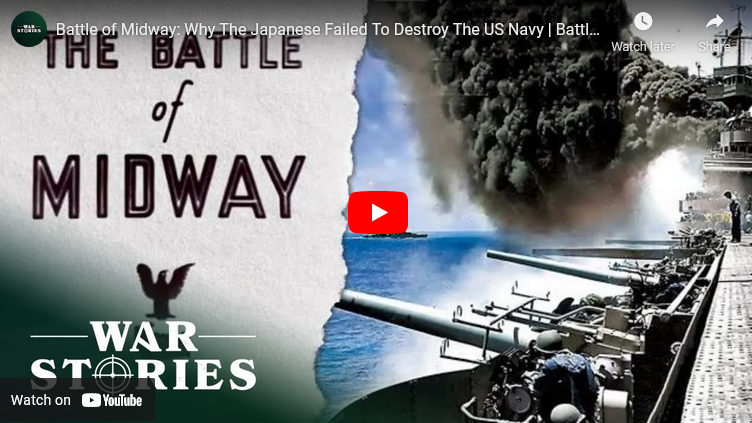
The Battle of Midway changed the course of the Pacific War in June 1942. In only a few days, the United States sank four Japanese aircraft carriers and stopped a major Japanese move toward Midway Atoll.
The victory did not come from one lucky bomb or one heroic pilot. It came from intelligence, planning, carrier aviation, brave crews, and a narrow window of time when several things went right at once.
Only six months earlier, the attack on Pearl Harbor had badly damaged the U.S. Pacific Fleet. Japan had moved across a wide part of the Pacific and seemed hard to stop.
Midway Atoll was small, but its location mattered. It sat northwest of Hawaii and gave the United States an air base and an important outpost in the central Pacific.
Japan hoped an attack on Midway would draw the remaining U.S. carriers into battle. The plan was to seize the atoll and destroy those carriers.
Instead, American forces knew an attack was coming. That changed everything.
Codebreakers Gave Nimitz an Edge
U.S. Navy radio intelligence had been working on the Japanese naval code known as JN-25. The Americans could not read every message, but they recovered enough pieces to build a useful picture of Japanese plans.
The Japanese used the code name “AF” for the coming target. American analysts identified AF as Midway. By late May, intelligence also helped confirm that the main attack was expected around June 4.
The Naval History and Heritage Command describes the work of Commander Joseph Rochefort and Station HYPO as a key part of the American advantage before the battle.
Admiral Chester Nimitz used that information to position the carriers Enterprise, Hornet, and the quickly repaired Yorktown northeast of Midway.
Japan Brought Four Front-Line Carriers
The main Japanese carrier force included Akagi, Kaga, Soryu, and Hiryu. Their air groups were experienced and had helped drive Japan’s earlier victories.
But Japan’s operation was spread across a large area. Parts of the fleet were separated, and Japanese commanders did not know the American carriers were already waiting nearby.
A good history of the campaign can help put the ships and decisions in context. Readers looking for a deeper account can browse Battle of Midway history books or a broader Pacific War history.
June 4: The First Air Strikes
Early on June 4, Japanese aircraft attacked Midway. The island’s defenders fought back with fighters and anti-aircraft guns, while American aircraft searched for the Japanese carriers.
American torpedo squadrons attacked at low level and suffered terrible losses. Their torpedoes did little damage, but their attacks kept pressure on the Japanese force and pulled defending fighters down toward the sea.
Then U.S. dive bombers arrived from above. In a short span of time, bombs hit Akagi, Kaga, and Soryu. Fires and explosions left all three carriers doomed.
Hiryu Struck Back
The fourth Japanese carrier, Hiryu, was still able to launch counterattacks. Its aircraft hit Yorktown with bombs and torpedoes and badly damaged the American carrier.
Later that day, U.S. dive bombers found Hiryu and hit it as well. Japan had now lost all four carriers in the main striking force.
The losses were not only ships. Japan also lost many skilled aviators and experienced carrier personnel who were difficult to replace.
Why Midway Was a Turning Point
Midway did not end the Pacific War. Hard fighting continued for more than three years. But the battle broke the momentum of Japan’s early advance and cost it four of its most important carriers.
The United States could replace ships, planes, and trained crews at a pace Japan could not match. From this point forward, the balance of carrier power began moving toward the United States.
World War II losses can be hard to grasp as numbers alone. FootageVault’s look at The Fallen of World War II shows why visual storytelling can help us understand the human scale behind those figures.
Planning Matters, but So Does Timing
The American victory grew from good intelligence and sound planning. It also depended on timing. The dive bombers reached the Japanese carriers at a moment when the fleet was under pressure and fighter cover was pulled low.
Military planning still depends on training, communication, logistics, and forces that can work together. A modern example can be seen in this overview of how NATO coordinates planning and defense, even though the technology and political setting are very different from 1942.
Midway Fits a Larger Story of American Battles
Midway was a naval and air battle, but many of the same themes appear in other conflicts: incomplete information, quick decisions, local courage, and plans that change once fighting begins.
The Battle of Carthage shows those pressures in the opening months of the American Civil War, while the Battle of Corydon shows how a fast-moving raid forced local defenders to react with little time.
The Lasting Lesson of Midway
Midway was won by people using information, training, machines, and judgment under extreme pressure. No single part explains the whole victory.
The battle remains important because it shows how intelligence can change a plan before the first shot is fired, and how a few decisive hours can redirect a much longer war.