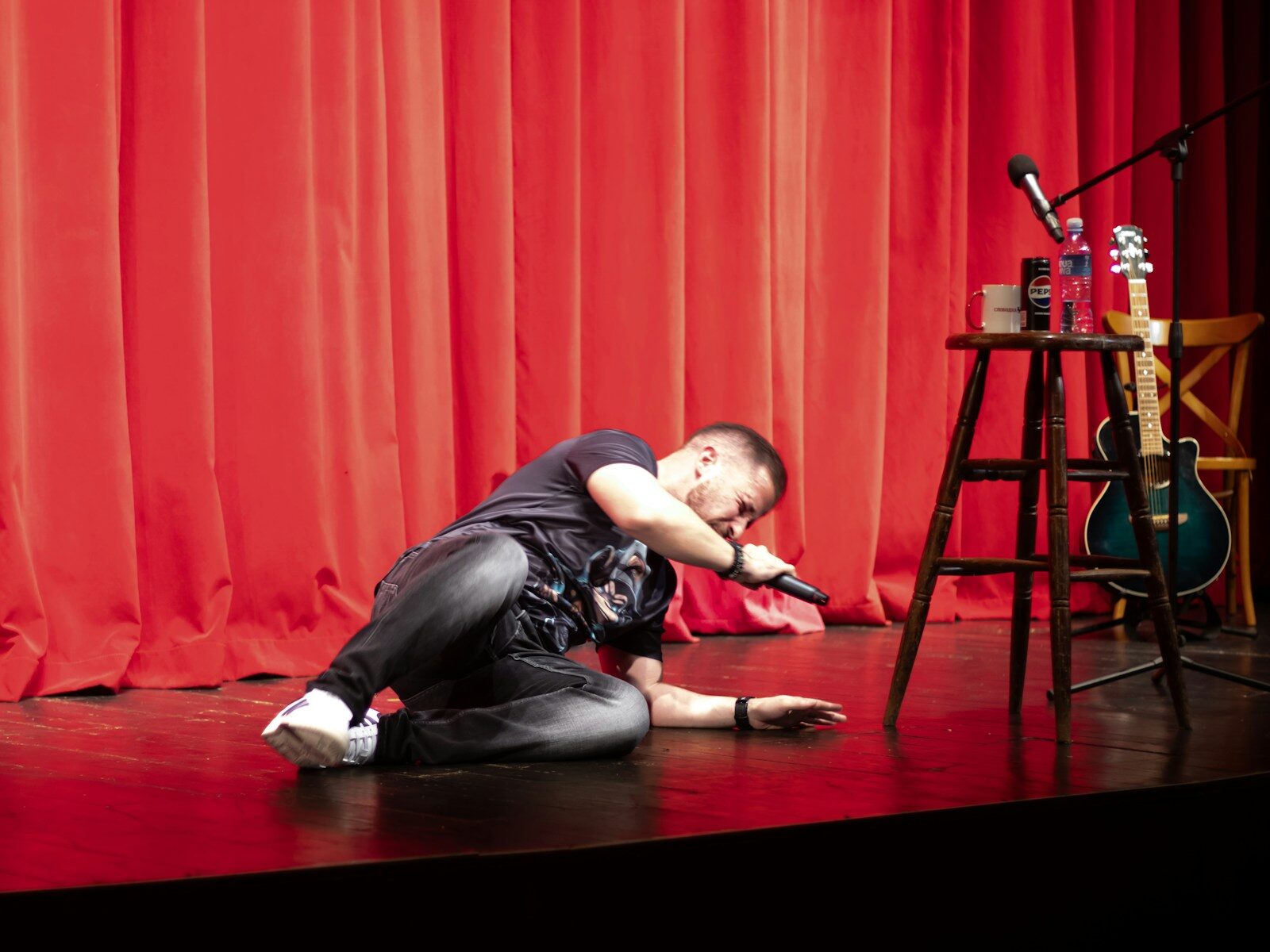
Stand-up comedy looks simple. One person walks on stage, holds a mic, and tries to make a room laugh. Doing it for the first time can still feel huge.
The good news is that stand-up is a skill. You do not need to feel fearless before you begin. You need a few jokes, a short plan, and enough nerve to try one open mic.
Your first goal is not to become great in one night. It is to finish a short set, learn what happened, and come back with a better version.
That takes pressure off. A quiet set is not the end. A strong set is not the finish line. Both give you useful information.
Start with material you can say in your own voice. Work, family, dating, driving, food, phones, hobbies, and awkward daily moments are all fine places to begin.
If writing jokes interests you as much as performing them, our guide on how to become a comedy writer goes deeper into building samples and improving your writing habits.
Write one short set first
Do not try to write an hour. A few minutes is plenty for a first open mic. Pick two or three topics you know well and write short ideas around them.
A basic joke often has a setup and a surprise. The setup tells the audience what to expect. The punch line turns that expectation in a different direction.
Keep the setup as short as you can. If a word does not help the audience understand the joke or enjoy the punch, try cutting it.
Then add tags. A tag is another short laugh that comes after the main punch line without needing a whole new setup.
Study why other comedy works
Watching good comedy can help if you watch with a purpose. Ask where the surprise happens. Notice how long the setup lasts. Listen for pauses and repeated words.
Our breakdown of why “The Expert” comedy sketch feels so true is useful for seeing how recognition, tension, and escalation can create laughs.
It also helps to watch experienced comics who make storytelling feel natural. Our profile of Gabriel “Fluffy” Iglesias looks at how a strong point of view and clear stories can connect with a wide audience.
Practice out loud
Comedy is written for ears, not just eyes. Read your set out loud. A line that looks fine on a page may feel clumsy when you say it.
Time the set. Speak a little slower than your nervous brain wants to speak. Leave room after punch lines so an audience has time to laugh.
Record yourself on your phone. Listen once for extra words. Listen again for pace. You will hear habits that are hard to notice while you are talking.
If you want a reference beside you while writing, a stand-up comedy writing book can give you exercises and examples to work through between sets.
Find an open mic
Open mics are where many comics test new material. Rules vary, so check the venue before you go. Some use a sign-up list. Others use a lottery. Set times can also vary.
The Laugh Factory’s official open mic page, for example, lists its current sign-up rules and short set times by location. That is a good reminder to check each room instead of assuming every mic works the same way.
Arrive early. Watch the room. Listen to the host. Find out what the time signal looks like, and stop when your time is up.
What to do when you feel nervous
Nerves are normal. They do not mean you are not ready. Give yourself a simple job: walk up, say the first line, and keep going one line at a time.
Put a short set list where you can see it. If you blank, look at the next cue and continue. The audience does not know what you planned to say.
Live performance gets easier when the room itself stops feeling strange. Even visiting a local venue such as the Plowright Theatre in Scunthorpe, which hosts touring comics and other stage shows, can help you notice how performers use a real room, stage, lights, and audience.
Your first open mic plan
- Bring a short set you have practiced out loud.
- Arrive early enough to learn the sign-up system.
- Watch a few comics before your turn.
- Start with a joke you know well.
- Watch for the time light and finish on time.
- Stay and support other performers when you can.
Review the set while it is fresh
After the set, write down what got a laugh, what got silence, and where you felt rushed or unsure. Do this before the memory gets fuzzy.
Do not throw away every joke that missed. Try a shorter setup, a clearer word, a different order, or a stronger punch line. One small edit can change a joke a lot.
Keep the parts that work. Change one or two weak spots. Then take nearly the same set back on stage. Repetition makes it easier to tell whether an edit actually helped.
A simple four-week beginner plan
Week 1
Write short jokes. Pick the best ones. Put them into a short set and practice it aloud.
Week 2
Try one or two open mics. Record the sets if the venue allows it. Use mostly the same material both times.
Week 3
Cut extra words. Add a few tags. Move your strongest joke closer to the start or end.
Week 4
Try another room. Keep most of the set stable and test one new bit. Notice whether you feel calmer than you did on night one.
Bottom line
You do not become a stand-up comic by waiting until you feel ready. You write a few jokes, practice them, try a mic, learn, and repeat.
The first set may feel awkward. That is fine. Finish it, write down what you learned, and build the next one from there.